
What a real gravel driveway costs in the Upper Cumberland
Most projects run $3,000 to $7,500. A typical one is about $5,100. No two driveways price the same, and the ones that last are priced on what's under them.
$3,000–$7,500
Most projects land in this range.
- Smaller jobs (re-grade and compact, or a small top-up) about $1,500–$3,000
- Recovery with new stone $3,300–$7,600
- Full rebuild on a long or steep drive $12,000–$21,000
That's not a quote. It's an honest range, so you know what kind of numbers we work with before you pick up the phone. The only way to get a real number is to put eyes on your driveway, and that's the first thing we do.
The six things that set the price
We walk every one of them with you on site.
Driveway length and width
More ground means more material, more time and more fuel. Some costs, like getting equipment there and preparing the base, stay about the same whatever the length.
Slope and terrain
Steep drives take longer to grade and compact right, and they need more drainage work and often more material. Flat is faster; hills aren't.
Drainage issues
Water is usually why you're calling. Fixing it, with culverts, ditches or regrading, is part of the job, not an add-on.
Site access
If equipment can't easily get to the work, the work takes longer and costs more. Rocky ground, trees and tight spots all add time.
Gravel type and quality
Angular stone that locks together costs differently than rounded river rock that rolls downhill the first hard rain.
Base preparation
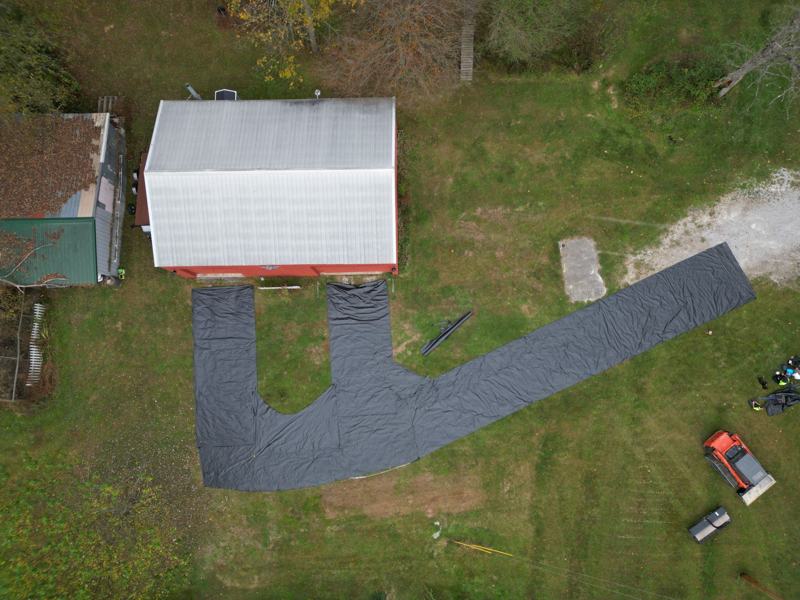
A driveway is only as good as what's under it. On steep slopes and soft soil, geotextile fabric is often what keeps the gravel from mixing into the mud.
What a complete project includes
- Site assessment and drainage planning. We walk it, read the water and tell you what's actually wrong.
- Grading and base preparation. Re-crown and re-level so water sheds off instead of pooling.
- Geotextile fabric where it's needed. The layer that keeps your stone from sinking into mud.
- The right depth of good gravel. Enough material to carry the load, compacted, not spread thin to look done.
- Erosion and washout fixes. Drainage, ditching or armored rock where the water wants to run.
When you compare quotes, ask what each one includes, so you're comparing the same job.
Repair or rebuild?
Not every driveway problem needs a full rebuild. Sometimes targeted repairs and drainage work can extend the life of your existing driveway for a fraction of the cost. We'll tell you honestly when a repair makes sense and when you're better off starting fresh.
If your driveway has ongoing drainage problems, severe erosion or washouts, a base that's failing, or you're adding gravel constantly just to keep it usable, a rebuild is usually the better investment.
“The real question isn't ‘what's the cheapest option?’ but rather ‘what's the best value for a driveway that will perform well for years to come?’”
Gravel Driveway Recovery
“We are very satisfied with the quality and value of the work. We particularly like the seamless junction to the public road and the excellent compaction. They work very hard and have excellent equipment. Highly recommend.”
A 5.0 rating from 100+ Google reviews. Read all our reviews on Google
Ready for a real number on your driveway?
Get an on-site look. We'll come see it, tell you what we see and give you a real number, not a guess. You can also email info@graveldrivewayrecovery.com.
Call or text(931) 400-8002